
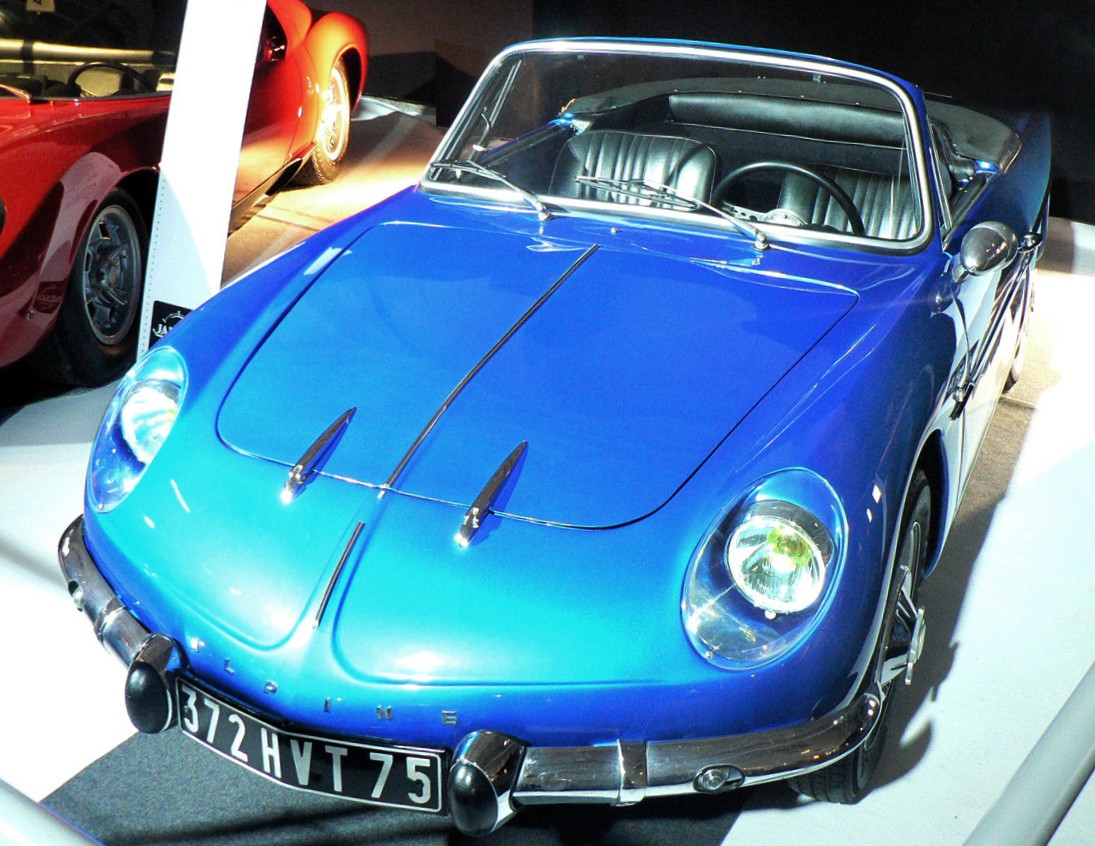
The A108 was a coupe version of Michelotti’s restyled A 106 cabriolet, based on the 4CV’s Dauphine successor. It appeared with the A106 at the ’57 Paris show powered by a 37bhp Gordini version of the Dauphine’s four-cylinder 845cc engine. Like its predecessor the A108 was glassfibre-bodied on a pressed steel platform. But Rédélé developed a more advanced version called the GT4, which used a steel backbone chassis, cradles at either end carrying the suspension, powertrain and steering gear. It rode on a 7cm longer wheelbase and appeared in 1963, only a year after the Lotus Elan was launched using the same arrangement.
Although less than 100 GT4’s were built, its structural composition was the basis for the legendary A110, whose styling was a highly successful evolution of the A 108’s look. Rédélé’s dream of overseas production was also realized with the A108, the car built under licence in Brazil by Willys-Overland to become the country’s first sports car. Renamed the Willys Interlagos, it was produced in Sao Paolo and enjoyed plenty of competition success. An impressive 822 were built from 1960 to 1965 – more than the 236 Alpine A108s built in Dieppe between 1960-62.
A108: THE FIRST BERLINETTE
Should we talk about the A108 or the A108s? There were so many different body types and configurations that it is difficult to paint an accurate picture of the history of a model of which 236 examples were built between 1958 and 1965.
The A108 appeared for the first time at the 1957 Paris Motor Show. The body of the A106 ‘Coach’ – produced by Chappe & Gessalin – and the RDL cabriolet were initially retained, with the real changes taking place under the bonnet: the engine from the 4CV was replaced by the 845cc ‘Ventoux’ powerplant from the Renault Dauphine. Over time, it became possible to instead opt for a re-bored 904cc unit prepared by Marc Mignotet, or the 998cc engine from the Dauphine Gordini.
The style evolved too, based on a variant of the A106 conceived by Philippe Charles, a young designer aged just 17! Using the Michelotti-designed cabriolet as his starting-point, he covered the headlights with a Perspex bubble and made the rear of the car longer so as to achieve a slimmer and more streamlined shape. Jean Rédélé entered two of these berlinettes for the 1960 Tour de France Automobile (for Féret and Michy) and the model’s critical success was such that the new look was soon transferred across to the cabriolets and ‘Coupé-Sports’ produced by RDL.
Another significant corner was turned in 1961, with the generalisation of the ‘beams and backbone’ chassis across all models. This architecture was based on a robust central beam, onto which were grafted side rails that supported the front and rear sub-frames. Enhancing stiffness and reducing weight, this innovation would be the secret behind the superb handling of Alpine cars throughout the generations.
You must be logged in to post a comment.