
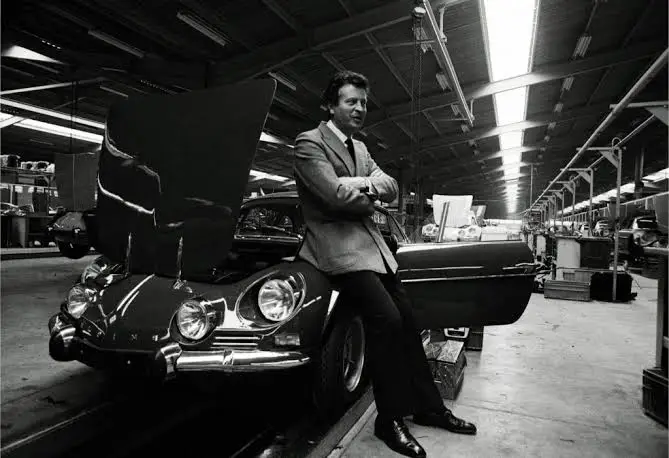
Jean Rédélé, was an automotive pioneer, pilot and founder of the French automotive brand Alpine. With a HEC diploma, he was the youngest Renault dealer in France, with a dealership installed in Dieppe. Born: May 17, 1922, Dieppe, France. Died: August 10, 2007 (age 85 years), Paris, France
With the benefit of hindsight, Jean Rédélé’s destiny was clear to see. Raised from a very young age in a world dominated by cars, racing and Renault, he also distinguished himself through an avant-garde vision of technology and business. Jean was the eldest son of Émile Rédélé, a Renault dealer based in Dieppe and formerly an official mechanic for Ferenc Szisz, the brand’s first ‘factory driver’ back at the beginning of the century. Once he had completed his studies at HEC business school in Paris, Jean came to the attention of Renault’s management for his ground-breaking business ideas. At the age of just 24, he became the youngest car dealer in France as he followed in his father’s footsteps.
Reasoning that ‘motorsport is the best way to test production cars and victory is the best sales tool’, Jean Rédélé entered his first competitive events four years later, at the age of 28.
After a trial run at the Rallye Monte-Carlo in 1950, he triumphed in the inaugural Rallye de Dieppe behind the wheel of the new 4CV, defeating a plethora of significantly more powerful rivals! This nationally-acclaimed victory convinced Renault to entrust him with a 4CV ‘1063’ – the special racing version – for the following season. While this enabled him to maintain his run of success, Jean Rédélé worked hard to improve the performance of his vehicle. This quest led him to Giovanni Michelotti, from whom he ordered a 4CV ‘Spéciale Sport’, the chief feature of which was an aluminium body that was rather more aerodynamically streamlined than the original vehicle. Over the course of time, this collaboration between the French rally driver and the Italian designer gave birth to three unique models.
While awaiting the delivery of his new car, Rédélé continued to compete in his ‘1063’ as his friend Louis Pons – a Renault dealer in Paris and Etampes – became his co-driver. Always seeking to enhance performance, the pair funded the development of a five-speed gearbox, designed by André-Georges Claude. This played a particularly important role in their record-breaking class victory in the Mille Miglia, the famous road race held between Brescia and Rome.
Jean Rédélé’s career path next took him to the Le Mans 24 Hours and Tour de France Automobile. In 1953, he finally got his hands on his 4CV ‘Spéciale’, and on his very first outing in the car, he won the 4th Rallye de Dieppe ahead of two Jaguars and a Porsche! The following year, the Rédélé/Pons pairing triumphed in their class for the third time on the Mille Miglia, before going on to prevail in the Coupe des Alpes. “I thoroughly enjoyed crossing the Alps in my Renault 4CV, and that gave me the idea of calling my future cars ‘Alpines’, so that my customers would experience that same driving pleasure,” he would later reveal.
The notion of creating his own brand preyed upon Jean Rédélé’s mind, and it was his father-in-law who helped him to turn his dream into reality. Owner of the Grand Garage de la Place de Clichy on rue Forest, Charles Escoffier was one of the leading Renault dealers of the era. When he asked his son-in-law to assist with the development and marketing of a series of ‘Coaches’ already commissioned from Gessalin & Chappe, it proved to be the catalyst for the foundation of the ‘Société des Automobiles Alpine’ on June 25, 1955.
A108: THE FIRST BERLINETTE
Should we talk about the A108 or the A108s? There were so many different body types and configurations that it is difficult to paint an accurate picture of the history of a model of which 236 examples were built between 1958 and 1965.
The A108 appeared for the first time at the 1957 Paris Motor Show. The body of the A106 ‘Coach’ – produced by Chappe & Gessalin – and the RDL cabriolet were initially retained, with the real changes taking place under the bonnet: the engine from the 4CV was replaced by the 845cc ‘Ventoux’ powerplant from the Renault Dauphine. Over time, it became possible to instead opt for a re-bored 904cc unit prepared by Marc Mignotet, or the 998cc engine from the Dauphine Gordini.
The style evolved too, based on a variant of the A106 conceived by Philippe Charles, a young designer aged just 17! Using the Michelotti-designed cabriolet as his starting-point, he covered the headlights with a Perspex bubble and made the rear of the car longer so as to achieve a slimmer and more streamlined shape. Jean Rédélé entered two of these berlinettes for the 1960 Tour de France Automobile (for Féret and Michy) and the model’s critical success was such that the new look was soon transferred across to the cabriolets and ‘Coupé-Sports’ produced by RDL.
Another significant corner was turned in 1961, with the generalisation of the ‘beams and backbone’ chassis across all models. This architecture was based on a robust central beam, onto which were grafted side rails that supported the front and rear sub-frames. Enhancing stiffness and reducing weight, this innovation would be the secret behind the superb handling of Alpine cars throughout the generations.
THE WILLYS-INTERLAGOS: TESTAMENT TO AN INNOVATIVE EXPORT POLICY
Whilst well aware that international expansion would likely yield fresh channels of growth, Jean Rédélé came up against insufficient finances, meaning he was unable to create and develop a traditional export network. Undeterred, he found another way in suggesting to industrial partners that they manufacture his cars under licence.
It must be said that Alpines were relatively easy to assemble, even for unqualified labour. They were also highly-regarded for their reliability, since they used mass-produced mechanical components from Renault.
Following a failure in Belgium – where less than fifty A106s were manufactured by the Small factory – it was in Brazil that Rédélé achieved a breakthrough. The Willys-Overland firm, which already manufactured Dauphines under a Renault licence, began production using equipment supplied by the Dieppe factory. From 1960, ‘Interlagos’ models – named after the famous Brazilian motor racing circuit – left the Sao Paulo workshop. At first glance, only the trained eye could distinguish an ‘Interlagos’ from its Alpine A108 sister car.
This partnership continued with the A110, and in total, around one thousand berlinettes and cabriolets were produced up until 1966.
As in France, these Alpines manufactured across the other side of the Atlantic proved to be very capable in motorsport, most notably in endurance races such as the Mil Milhas. Indeed, it was after starting out in ‘Interlagos’ models that the likes of Carlos Pace, Emerson Fittipaldi and brother Wilson Fittipaldi headed to Europe in order to climb the career ladder all the way up to Formula 1.
This collaboration served as a model for similar agreements in Mexico (Dinalpin), Spain (Fasa) and Bulgaria (Bulgaralpine). All-in-all, nearly 15 per cent of Alpines were built under licence abroad.
THE A110: QUITE SIMPLY A LEGEND
In providing the visual identity conceived by Philippe Charles and the ‘beams and backbone’ chassis architecture, the A108 laid the foundations for the A110, which appeared in 1962. As the 4CV had done for the A106 and the Dauphine for the A108, it was the R8 that acted as a parts bank for Jean Rédélé’s latest creation.
The relationship with Renault – close from the very first day – was further strengthened when the French manufacturer tasked Alpine with representing it in motorsport. What’s more, from 1967, every car produced would bear the official name ‘Alpine-Renault’.
Buoyed by the brand’s excellent results in rallying, the Berlinette went on to achieve tremendous commercial success. In order to respond to increasing demand, Alpine found itself needing to adapt its manufacturing set-up, with production henceforth shared between the workshop on avenue Pasteur, the original Dieppe factory and the new plant in Thiron-Gardais (Eure-et-Loir).
Over the course of its different versions, the A110 evolved constantly. The 1108cc engine was succeeded in-turn by 1255cc, 1296cc, 1565cc and 1605cc units. Outward changes were minor, but frequent: a grille incorporating four headlights, extended wheel arches, front radiator, removable rear apron… In 1977, production drew to a close with the 1600SX, fitted with a 1647cc powerplant.
FROM THE BERLINETTE TO THE GRAND TOURISME
Designed in compliance with the instructions of Jean Rédélé himself, the Alpine A310 looked set to enable the brand to capitalise upon the success of the Berlinette – but the oil crisis of 1973 brought a shuddering halt to the upward momentum and caused a significant drop in sales. Bit by bit, Alpine picked itself back up by evolving its new model, introducing fuel injection in 1974, the V6 PRV engine in 1976 and the same rear suspension as the Renault R5 Turbo in 1981…
In 1985, the new GTA made its debut. This model marked a further departure for Alpine from the spartan concept of the Berlinette as it turned its attentions towards the Grand Tourisme world. In its range-topping version complete with V6 Turbo engine, the GTA generated some 200hp, which led the media to dub the car as a ‘fighter jet for the road’!
In 1990, the A610 joined the Alpine line-up with a 2,963cc V6 Turbo powerplant. Despite the press praising its handling abilities and dynamic performance, this model struggled to find its niche amongst the public and was discontinued in 1995.
After production of the A610 ceased, the Dieppe factory focused its efforts on the manufacture of numerous high-performance models for Renault Sport, from the R5 Turbo to the Clio R.S., Renault Sport Spider and Clio V6, much like the Renault 5 Alpine had been made there before them. Today, this historic site – which has always proudly retained the Alpine logo on its walls – is right at the heart of the brand’s rebirth.
THE ALPINE RENAISSANCE
Frequently debated and palpably desired by fans for almost 20 years, the Alpine brand’s revival by Renault needed to be handled correctly if it was to prove a success. Expectations were so high that disappointment simply wasn’t an option!
The unveiling of the Alpine A110-50 concept car to mark the 50th anniversary of the Berlinette in 2012 represented a timely litmus test as to whether the interest was still strong. It was.
On November 5, 2012, Carlos Ghosn officially announced the rebirth of Alpine and a design project for a ‘21st Century Berlinette’, scheduled for completion in 2016.
When no fewer than five A110s were entered for the 2013 edition of Rallye Monte-Carlo Historique – 40 years on from Alpine’s famous one-two-three finish in 1973 – the enthusiasm generated was such that reneging on the decision to revive the brand was no longer an option!
With Bernard Ollivier at its helm, Société des Automobiles Alpine is now hard at work on the new ‘21st Century Berlinette’. The general concept and style are already fixed, with efforts currently focused on the design of individual parts, modelling and production. To this end, substantial investment has been made in the Dieppe factory, while disguised prototypes have been on the road to evaluate a variety of different technological solutions.
Whilst preparing for the introduction of this new model, Alpine is honouring its proud motorsport heritage with a hugely successful participation in the European Le Mans Series and – since the beginning of 2015 – the WEC (World Endurance Championship). This period has also seen the brand’s return to the Le Mans 24 Hours.
In 2015, away from the racetrack, Alpine has also stolen the limelight by successively unveiling two significant show cars.
– The Alpine Vision Gran Turismo: as the star of an eponymously-named video game, this car embodies all the passion so synonymous with Alpine by blending sportiness and modernity. The Alpine Vision Gran Turismo projects Alpine’s famous arrowed ‘A’ logo into a new dimension in an entirely original manner.
– The Alpine Celebration: the clue here is very much in the name – this show car has been specially designed to celebrate the 60th anniversary of the company founded by Jean Rédélé. Drawing upon the stylistic cues of some of the most iconic cars from the brand’s history, the Alpine Celebration pays tribute to Alpine’s motorsport-honed DNA and created surprise and emotion with its appearances at the legendary Le Mans 24 Hours and Goodwood Festival of Speed earlier in the year.
THE ALPINE VISION GRAN TURISMO
The Alpine Vision Gran Turismo – fruit of the collective imagination of the designers and engineers entrusted with developing the 21st Century Berlinette –blasted into homes all over the world in March, 2015. Every owner of the game Gran Turismo 6 can download this virtual model and find themselves behind the wheel of the most incredible Alpine yet. As the icing on the cake and to appeal to the eyes, this concept car has also been produced in the form of a full-scale model.
The story began in July, 2013, when Polyphony Digital Inc. – the studio responsible for the development of PlayStation® Gran Turismo – encouraged Alpine to take up the challenge of designing a virtual car. On both sides of the table, the enthusiasm and passion for this project were mutual. The Alpine teams immediately threw themselves into the exciting initiative with the same commitment as they have shown for the development of the forthcoming road model.
An in-house competition involving around 15 designers was won by the project submitted by Victor Sfiazof: “It’s a genuine sportscar which combines the passion for cars with enjoyment behind the wheel. There are numerous references to the past, present and future. The idea of a ‘barquette’ stemmed from the Alpine A450’s involvement in the Le Mans 24 Hours. That said, the front end takes its inspiration from the A110, and the vertical fins at the rear recall the A210 and A220 while making a real contribution to the car’s styling. As an aeronautic fan, I wanted to incorporate cues from the world of aviation, too. The airbrakes add a nice high-tech touch to the rear end. This exclusive model similarly integrates hints of the future Alpine, but we can’t say any more about that just yet!”
The guided tour of the Alpine Vision Gran Turismo begins with the front of the car, which bears a striking resemblance to the A110. The sloping V-shaped bonnet is enhanced by a central crease and, in another nod to the 1960s, the cross-shaped LED lights recall the black tape that was used to protect the additional lights fitted to the Berlinette rally cars. These references to the past blend in seamlessly with an undeniably modern aerodynamic package which includes a splitter designed to channel airflow along the body sides. It also provides a glimpse of the suspension wishbones.
The car’s profile awakens other memories. The air that escapes behind the front wheels is directed through large intakes, which accentuate the narrow form of the body. Complementing the overall harmony, the long lateral rear fins call to mind the A210s and A220s which shone so brilliantly in the Le Mans 24 Hours.
The appeal of the Alpine Vision Gran Turismo is further enhanced by its open cockpit. The driver sits on the right, a design typical of sport-prototype cars given that the majority of circuits run in a clockwise direction.
The rear-end design – the most popular view amongst gamers – represents an unmistakeable highlight of the Alpine Vision Gran Turismo. The flat bottom that runs beneath the car terminates in arched form, while a lower wing links the wheel arches to the stern. As at the front, the bodywork exposes the double wishbone suspension. The most striking characteristics of the Alpine Vision Gran Turismo become apparent under braking. Integrated into the profile of the tail, the hydraulically-activated airbrakes can be deployed in an instant, while at the same time revealing the brake lights!
The Alpine Vision Gran Turismo might be a virtual machine, but it was nonetheless duty-bound to adopt driving dynamics and handling characteristics worthy of its glorious predecessors. Terry Baillon, a simulation and chassis development engineer for the forthcoming production model, therefore treated this vehicle as if it would one day take to the road for real: “Right from the outset of the project, we set performance and handling targets for the Alpine Vision Gran Turismo. We then transcribed them into technical characteristics, with the object of achieving driving dynamics for players that are in keeping with what we envisioned back at the start. We used our own software in the development, before sending our data to Polyphony Digital to enable them to model the vehicle within the context of the video game.”
In front of the screen and holding either a steering wheel or a PlayStation Dual Shock® controller, long test sessions were required in order to refine the settings of the car. Blending elements of both the Alpine A450 racing car and the 21st Century Berlinette, the Alpine Vision Gran Turismo offers a few glimpses of the driving dynamics of the forthcoming road-going model, while at the same time displaying characteristics specific to Le Mans prototypes. Being a true Alpine, the accent is placed very much upon agility, spirit and driving enjoyment!
THE ALPINE CELEBRATION DIEPPE SHOW CAR
A compact sportscar inspired by Alpine’s motorsport heritage, the Alpine Celebration presented here in its Dieppe livery is a two-seater coupé with sleek, flowing lines. Its deep blue colour scheme recalls that of the Alpine prototype that made a victorious return to endurance racing in 2013, whilst its original detailing – created especially for the large Dieppe gathering – offers a clear nod to the rallying successes of the A110, which saw Alpine crowned world champion in 1973.
The Alpine Celebration Dieppe faithfully replicates the timeless style and attributes of Alpines of old whilst adding a modern twist. Its low profile, sloping, creased bonnet, sculpted sides, distinctive rear window and further details all pay homage to the A110 and other iconic models that have featured so prominently throughout Alpine’s glorious history.
With no need for gimmickry to stand out from the crowd, the beauty of the Alpine Celebration Dieppe is to be found in its simplicity. Mindful of remaining elegant whilst at the same time responding to the need for frugality and efficiency, the Alpine Celebration Dieppe show car reveals much about the brand’s heritage. It retains a familiar style and set of values which it integrates in a thoroughly modern manner. Carbon touches highlight the most technologically-advanced elements of the car’s body, such as the spoiler, lower side sill panels, diffuser, rear air intakes and door mirrors.
The positioning of the masked double headlamps and the central beams barred by a white cross will remind fans of the adhesive strips that used to be found on the headlights of Alpine’s rally cars. It was formerly an ingenious means of keeping them intact should they break.
The spoiler, which frames the vehicle’s evocative front end, is symbolic of strength and support, whilst efficiency is enhanced by the straight, sharp lines of the lower side sill panels. The door mirrors, meanwhile, take the form of a thin mirror that appears to float free of its housing to improve the car’s dynamic stance, as well as to exude a sense of light weight and aerodynamic efficiency. The famous Alpine arrowed ‘A’ can be seen on the air intake grille, the sides, the front wings and the roof.
The design of the wheel rims recalls a style that was popular on the A110 and A310 models during the 1970s. They reveal the prominent front brake discs and orange brake callipers. In the middle is a cast-look aluminium hub, which contributes to the overall design.
The athletic rear design incorporates the air intakes into the rear panels in order to facilitate engine cooling. The engine cover – which can be spied through the rear window shutters – confirms the mid-rear positioning of the engine block.
Above the wheel arches, scoops guide airflow in a manner that is unmistakeably Alpine. The rear of the vehicle is characterised by an impressive diffuser that incorporates a central rear light, flanked by two exhaust tailpipes in polished stainless steel. The approach throughout is very clearly to highlight the structural elements of the car rather than try to conceal them, which in turn prioritises lightweight agility and performance.
That said, the true focus of the presentation of the Alpine Celebration Dieppe is to be found in its design – all flowing, sensual curves – which single-handedly symbolises the very essence of French automotive style.
MOTORSPORT: A CONSTANT THEME THROUGHOUT ALPINE’S HISTORY
Founded by a skilled driver, Alpine is a brand whose history is punctuated by success in motorsport, from the Rallye Monte-Carlo to the Le Mans 24 Hours!
Even if the characteristics of the A106 ‘Coach’ did not particularly lend themselves to racing, in the hands of drivers of the calibre of Jacques Féret and Jean Vinatier, it nonetheless succeeded in securing some very creditable results, not to mention the outstanding second place claimed by Jean Rédélé himself on the 1955 Mille Miglia. Motorsport also served as the catalyst for the development and evolution of the A108, while providing the baseline for the A110.
Beginning in 1963, Alpine pitted itself against the gruelling Le Mans 24 Hours, targeting the ‘Performance Index’ and ‘Efficiency Index’ accolades rather than outright victory. With their small Gordini engines, the Alpines stood out for their aerodynamic efficiency. Two victories ensued, in 1964 with the M64 crewed by Henry Morrogh / Roger Delageneste and again two years later with the A210 piloted by Jacques Cheinisse / Roger Delageneste. There were also one-two-three finishes in the Energy Index classification in 1966 and 1968.
The Alpine name also achieved success in single-seaters, with Henri Grandsire winning the French F3 Championship in 1964. Several years later, Patrick Depailler (1971) and Michel Leclère (1972) repeated the feat.
In rallying, the A110 Berlinette swiftly showed itself to be a potent force. In 1968, Gérard Larrousse came close to winning in Monte-Carlo, but it was the team of ‘Musketeers’ who truly earned the Dieppe-based manufacturer its spurs within the sport. Alpine-Renault sporting director Jacques Cheinisse recruited a ‘dream team’ composed of Jean-Pierre Nicolas, Jean-Claude Andruet, Bernard Darniche and Jean-Luc Thérier. Other drivers would subsequently bolster this legendary quartet, such as Ove Andersson who triumphed in Monte-Carlo in 1971.
In 1973, the Alpine-Renault squad competed for the very first World Rally Championship title. The season began superbly, with a one-two-three finish for Andruet, Andersson and Nicolas in Monte-Carlo. Across 13 rounds, the Berlinette won six times and on every type of terrain: Monte-Carlo (Andruet), Portugal (Thérier), Morocco (Darniche), Acropolis (Thérier), Sanremo (Thérier) and Tour de Corse (Nicolas). The last of those victories saw Alpine conclude the campaign in fine style, with another top three lock-out to write the closing chapter of an extraordinary story! These results crowned Alpine-Renault World Champion, ahead of rivals Fiat Abarth and Ford.
The 1973 season also witnessed the re-launch of Alpine’s endurance racing programme, which had been halted after the disappointment of the A220 at the end of the 1960s. This time, the brand had the top step of the podium firmly in its sights. Victory edged closer year by year until it was finally achieved in 1978. Behind the wheel of the Alpine Renault A442-B, Jean-Pierre Jaussaud and Didier Pironi triumphed ahead of the A442 (crewed by Guy Fréquelin and Jean Ragnotti) which came fourth.
With its mission accomplished, Renault was able to turn its attentions towards Formula 1 with its 1.5-litre V6 turbo engine.
The Alpine A310 similarly enjoyed its days in the sun, tasting glory with Jean Ragnotti, Bruno Saby and Jean-Pierre Beltoise – French Rallycross Champions in successive years from 1977 to 1979 – as well as Guy Fréquelin, the 1977 French Rally Champion.
Following the organisation of the Alpine Europa Cup – contested as a curtain-raiser to Formula 1 Grands Prix with the GTA model – the brand’s motorsport activities drew to a close in 1988.
At the end of 2012, when Alpine’s revival was officially announced, a return to motorsport was immediately mooted. After forging a partnership with Signatech, the brand entered both the European endurance championship (ELMS) and the Le Mans 24 Hours. During its very first season (2013), the A450 lifted the European laurels. The Signatech-Alpine squad successfully defended its ELMS crown in 2014, while at the same time clinching an LMP2 class podium finish at Le Mans. This performance was accompanied by seventh position in the overall classification – the second-best result in the brand’s history at La Sarthe after its 1978 victory! Now the story is set to continue in 2015, with a confirmed ongoing commitment to endurance racing…
Alpine History
Alpine was born out of one man’s love for the Renault 4CV, his love for racing it and his considerable commercial acumen. Born in 1922, to the proprieter of a Renault dealership appointed by Louis Renault himself, Jean Rédélé was himself a Renault dealer by the age of 24. But first he went to business school and took an internship with Renault, his ground-breaking views on business strategy seeing him summoned by Renault CEO Pierre Dreyfus. That earned him the Renault concession in Dieppe.
Motorsport came four years later in 1950, Rédélé concluding that ‘racing is the best way to test production cars and victory is the best sales tool.’ He chose the brand new Renault 4CV as the vehicle for his competition ambitions. And won the Rallye de Dieppe on his second appearance, beating plenty of more powerful cars on the way. That lead to Renault providing a racing version of the 4CV for an attempt on the 1951 Rallye Monte Carlo, his fourth in class improving through the season until outright victory came in the Tour de Belgique.
But to go faster still, Rédélé concluded that the 4CV needed a lighter, more aerodynamic body, commissioned designer Giovanni Michelotti to design him one and in the meantime won his class in the 1952 Mille Miglia, and just missed out on a class win in at the Le Mans 24 Hours in the same year, both in the same racing 4 CV. By the end of a 1954 season that had been every bit as successful as 1953, Jean Rédélé had gained a reputation as a top driver. That meant a lot to him even if, deep down, he knew he would soon have to choose between driving his cars and driving his business.
The Michelotti-designed 4CV Spécial Sport would, by slightly circuitous means, become the Alpine A106 and Rédélé’s first production car.
‘I chose the name Alpine for my company because for me, this is an adjective that epitomises the pleasure of driving on mountain roads. The most fun I ever had behind the wheel was driving through the Alps in my five-speed 4CV, and it was essential for me that my customers should experience this same level of enjoyment in the car I wanted to build. In this respect, the name Alpine is both symbolic and entirely appropriate.’
Rédélé quickly appreciated the potential of a car brand, which he wanted to build based upon some basic principles. The cars should be innovative, equipped with simple but competitive mechanicals beneath a lightweight, attractive body, whilst using the greatest number of mass-produced parts possible in order to ensure low prices and maintenance costs in relation to the car’s performance.
His second aim was to boost his company’s domestic activity with the provision of international licences. Realising that his cars were relatively straightforward to assemble and that their Renault mechanicals made them reliable and easier to repair, he set about finding partners in markets where Renault was already present. Eventually Alpines would be assembled in Brazil, Spain and Mexico in some quantity, and in smaller numbers in Bulgaria.
This he achieved with the A106’s successor, the A108 a prelude to the legendary A110 that would cement the Alpine name as a major sports car marque capable of winning world championships. The Renault R8-based A110 Berlinette also achieved commercial success. Rédélé created a new Parisian branch by opening a Renault dealership in Epinay sur Seine, where he installed Alpine’s commercial headquarters, and in 1969 opened the now famous factory in Dieppe. Meanwhile the A110 Berlinette evolved constantly with ever-larger engines and minor but plentiful aesthetic changes. By 1977 some 7,500 had been produced, and the car had shone in every competitive arena it had entered from rallying to circuit racing and even ice-racing.
The A110 was a hugely competitive rally car in the late ‘60s and early 1970s, an eight year streak of repeated podium successes winning Alpine the World Rally Championship in 1973. Rédélé was nevertheless envisaging a completely new car. The A310, presented at the 1971 Geneva Motor Show, was initially offered with a 140bhp 1605cc four cylinder engine and later a 150bhp V6. More sophisticated than the A110, it was partly designed by Rédélé himself and intended to establish the brand in the sportscar and grand tourer market. Although the 1973 fuel crisis dented sales, over 11,600 were made before production ended in 1985, and it saw competition success in its early years, until the mid-engined Renault 5 Turbo – also produced at Dieppe – became the machine to beat.
Alpine’s motorsport ambitions lead a parallel life on the circuit with sports prototypes, the marque debuting at Le Mans in 1963. Initially, Alpine targeted performance and efficiency rather than outright victory. With their small 1000cc or 1300cc Gordini engines the cars were able to defeat their rivals thanks particularly to their carefully honed aerodynamics, an M64 winning its class at Le Mans in 1964. Plenty of success would follow, and some striking machines with it. Even Général de Gaulle was stopped in his tracks by the A211 when it featured on the Renault stand at the Paris Motor Show. The French President asked Rédélé, ‘What purpose does motor racing serve?’ To which he replied: ‘To put France on top, General!’.
Alpine contested the famous 24-hour race 11 times between 1963 and 1978, running a total of 55 factory cars. In addition to its successes in the ‘Energy Index’ classification in 1964, 1965 and 1968, as well as in the ‘Performance Index’ classification in 1968 and 1969, its efforts harvested seven class wins in total and, above all, outright victory in 1978 with the Alpine A442B prototype shared by Jean-Pierre Jaussaud and Didier Pironi. It was after this performance that the endurance programme was halted to concentrate instead on Renault’s 1.5-litre Turbo Formula 1 car, this developed out of the A500 single-seater developed by André de Cortanze, who headed Alpine’s research department.
Meanwhile the A310 was replaced in 1984 by the GTA (Grand Tourisme Alpine), this car benefiting from a very innovative build process, its body being the first in Europe to be constructed by means of high-pressure injection. This technique enabled the polyester body to be bonded to the chassis for excellent rigidity. The GTA also featured a very low drag coefficient and a well-furnished cabin that was a world away from the sparse cockpit of the A110.
Initially equipped with a 2849cc engine producing 160hp, the GTA was soon offered with a turbo, this 200bhp version the fastest French production car at the time. A 1990 facelift turned the GTA into the A610, production of all three versions reaching nearly 7000 units by 1995. Following the end of production of the A610, the Dieppe factory – which has always retained the Alpine logo on its walls – produced numerous performance models for Renault Sport.
After the agile ‘Renault 5 Alpine’ – nicknamed ‘skateboard’ following its performance on the 1978 Rallye Monte-Carlo – it produced 5112 mid-engine Renault 5 Turbos, 1685 Spiders from 1996 to 1999 and no less than 67,000 examples of the much-praised Clio Renaultsport from 2000 to the present day. Dieppe also built 1,333 Clio V6s between 2002-05 and continues to build an assortment of race cars including over 700 Clio Cup models.
Since 2012, Alpine has enjoyed an inspiring period of enthusiastic creativity and renewed momentum. Revived by the 50th anniversary of the Berlinette and brought to life in the shape of the stunning A110-50 concept, the brand has been preparing a new production car, and escalating a very successful return to motorsport.
Alpine’s motorsport ventures not only saw the Signatech-Alpine team scooping the title in the European Le Mans Series (ELMS) in 2013, but repeating this success in 2014. For 2015, the team is contesting a complete eight-round season of the World Endurance Championship (WEC), the Alpine A450b competing in the LMP2 class. The series includes the le Mans 24 hour race itself, and although a podium was achieved in 2014, this year retirement came after 110 laps. But the determined character of Alpine’s endurance racing history indicates that this is far from the end.
You must be logged in to post a comment.