
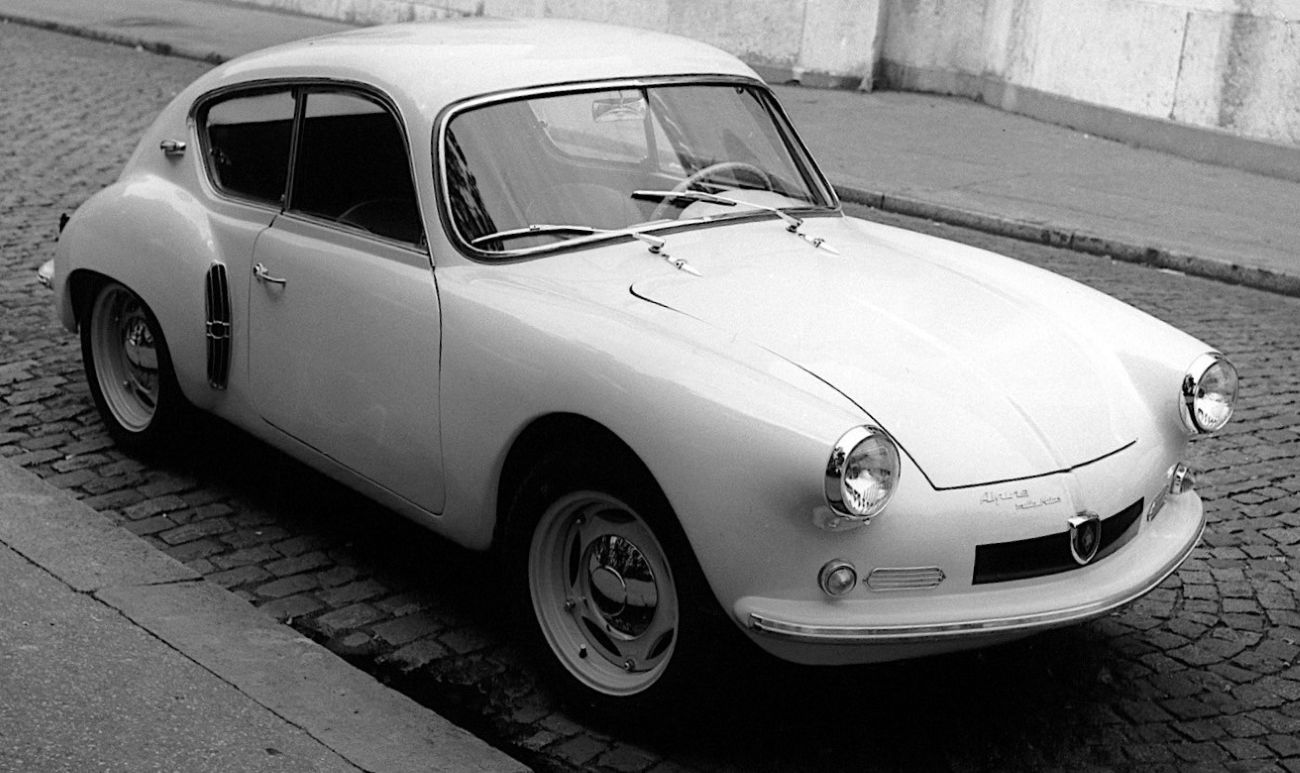
ALPINE A106
This striking ‘Coach’ – launched back in 1955 – was the very first Alpine, exhibiting the unmistakable hallmarks that would go on to characterise all of the Dieppe-based manufacturer’s future models.
The son of a Dieppe Renault dealer – whom he would subsequently succeed, in so doing becoming the youngest car dealer in France – Jean Rédélé threw himself into the competitive world of motorsport in 1950. His skill behind the wheel saw him tally excellent results and class triumphs in events as prestigious as the Rallye Monte-Carlo, the Mille Miglia, the Tour de France Automobile and the daunting Liège-Rome-Liège Rally.
These successes were achieved with a Renault 4CV, but Jean Rédélé had somewhat loftier ambitions: his dream was to produce a small French sports car using as many mass-produced parts as possible. Rédélé initially conceived two ‘Renault Spéciale’ models, designed by Michelotti and rebodied by Allemano. It was, however, the Chappe brothers – Saint Maur-based coachbuilders already accustomed to working with plastics – who played a key role in the birth of the Alpine A106, the elegant polyester body of which was based upon the platform of the Renault 4CV. The name of this model was an allusion to Jean Rédélé’s victory in the Critérium des Alpes, behind the wheel of a 4CV bearing the code number 106.
On June 25, 1955, the Société des Automobile Alpine was established.
On 6 October that year, the Alpine brand was officially launched and the A106 presented to the public for the first time at the Paris Motor Show. This model would mark the first chapter of the Alpine story, with 251 cars being produced between 1955 and 1959.
Rédélé’s first production car, the A106 was based on the popular 4CV saloon, highly tuned versions of which he had raced very successfully. Rédélé reckoned that with a special lightweight body the 4CV would be swifter still. In fact, he had already commissioned talented Italian designer Giovanni Michelotti to design aluminium coachwork for a lighter 4CV, this pretty one-off coupe built by coachbuilders Allemano. The 4CV Spécial Sport turned out to be a major giant-killer in the 1953 Dieppe rally.
At much the same Rédélé had become interested in glassfibre technology, had grown keener to become a car manufacturer in his own right and had heard about a wealthy American industrialist by the name of Zark W. Reed. Reed wanted to build plastic-bodied sportscar to sell in the US against MG and Triumph. The two met, and devised a plan for Reed’s Plasticar company to build a grp-bodied version of the Michelotti car called the Marquis. The project ultimately came to nothing, but provided inspiration for the A106, as did a second 4CV rebody Rédélé had ordered from Italian coachbuilder Allemano.
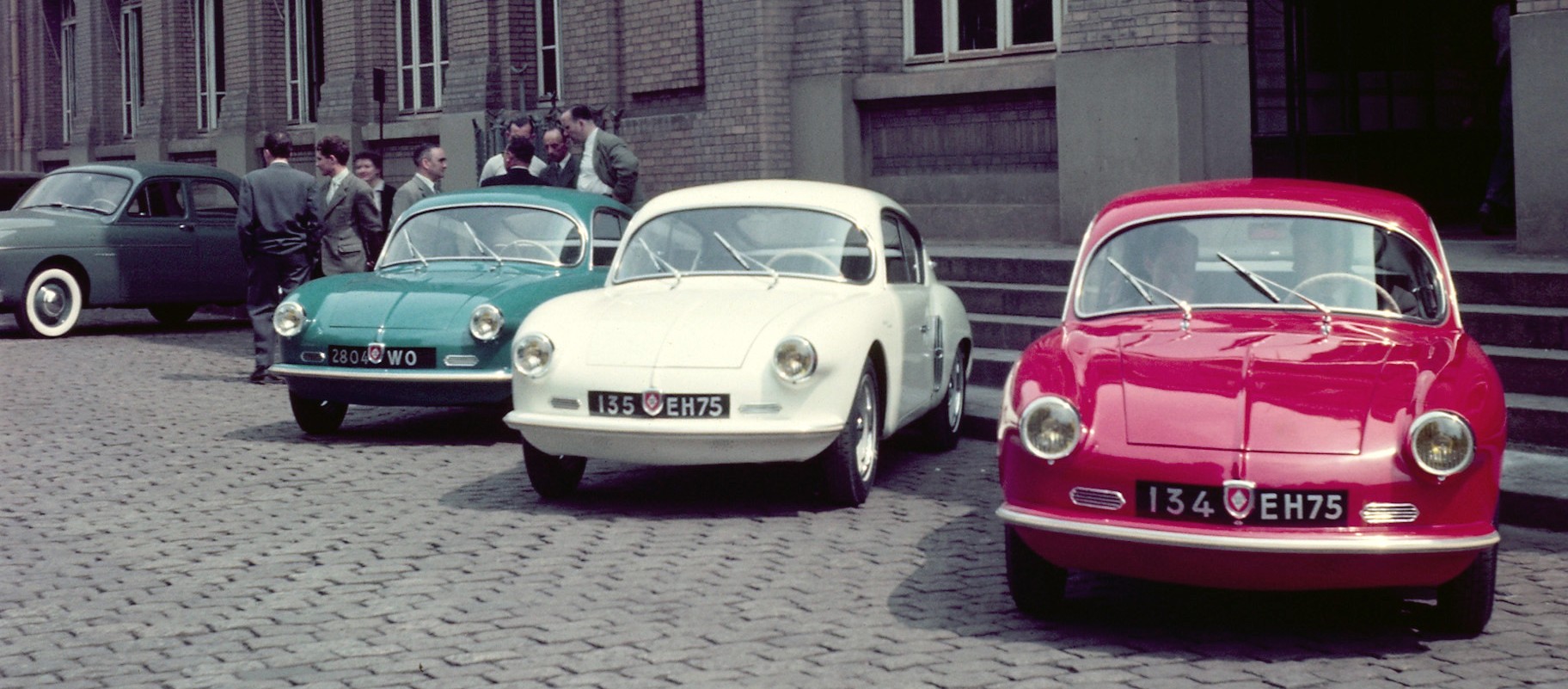
In 1955 Rédélé presented three A 106s in red, white and blue to Renault CEO Pierre Dreyfus, their glassfibre bodywork manufactured by Chappe et Gasselin. The A106 was primarily intended as a racing car and offered with various power outputs, suspension set-ups, weight reductions and a (pricey) five-speed gearbox option. But demand for road-going versions saw it appearing at the
1957 Paris motor show, alongside a new Michelotti-designed cabriolet. Larger Renault Dauphine engines and even a spaceframe chassis were eventually offered, 251 A106s produced between 1955-59 at the company’s Dieppe factory.
You must be logged in to post a comment.